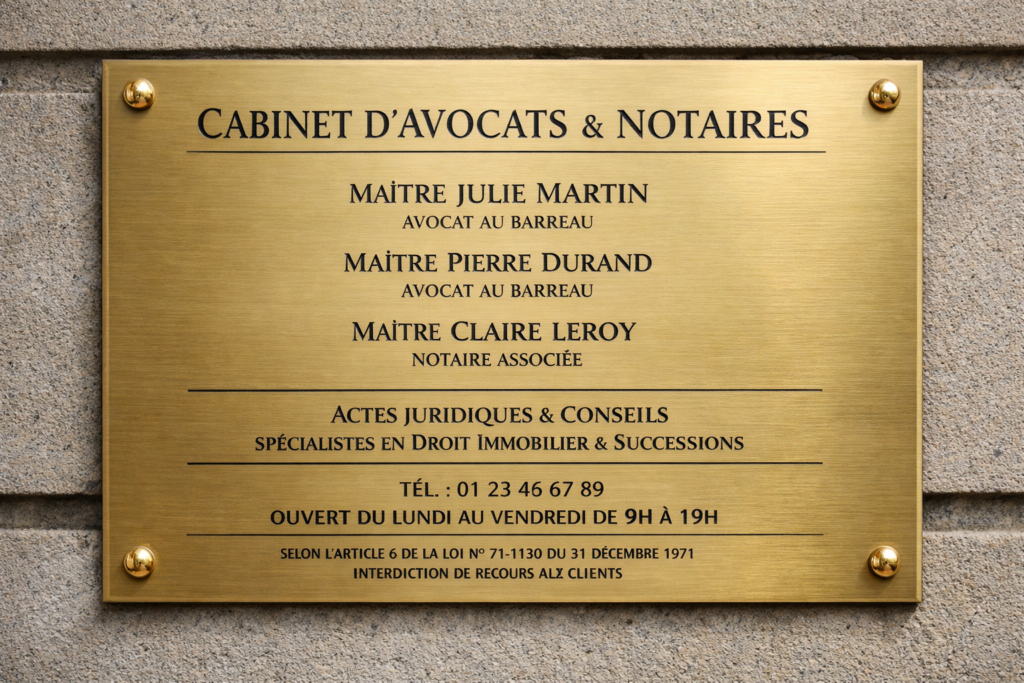
To practice in the legal sector, displaying a compliant professional plaque goes beyond aesthetics or visibility. Legal professions such as lawyers, notaries, or bailiffs are subject to strict standards regarding their office signage. From format selection, adherence to regulations, prior validation, to appropriate installation, the process of affixing one’s plaque deserves a thorough review.
Why comply with professional plaque legislation?
In the realm of regulated professions, every detail matters, especially when it comes to installing a professional plaque. The legislation primarily aims to ensure the discretion of the professional and to prevent any advertising drift contrary to the ethics of legal professions.
Ignoring these rules exposes one to administrative sanctions that can be severe on a disciplinary level. It is therefore essential to gather information on the specific regulations governing the plaque format, its dimensions, the information allowed or prohibited, as well as its exact placement. This vigilance helps maintain credibility and avoid complications with the bar association or other competent authorities.
Compliance: steps to follow
Proceeding step by step ensures obtaining a professional plaque that is impeccable in the eyes of the law. Here is a structured overview of the essential steps for legal professions wishing to install or renew their signage. For those considering modernizing their identification, purchasing a customized professional plaque is a relevant option that meets both regulatory and specific aesthetic needs of the firm.
- Verification of the applicable normative texts for your profession (decree, local order, ordinal recommendations).
- Selection of the format suitable for your activity among approved models.
- Choice of materials compliant with legislation (brass, plexiglass, aluminum, steel…)
- Clear definition of authorized mentions and restrictions related to advertising.
- Project validation with the competent order or bar association before final installation.
- Installation with fixings suitable for the type of wall or facade (concrete, brick, stone, cladding…)
In addition to this process, local particularities must be considered: some municipalities impose specific colors, sizes, or thicknesses. Seeking local advice remains a reassuring and essential reflex.
Standard plaque or custom-made: how to choose?
The big question when ordering often concerns the choice between a standard plaque or custom design. Standard models appeal due to their simplicity, quick availability, and lower cost. This type generally meets the dimensions required for legal professions: often 30 x 20 cm, without embellishment.
However, the requirements related to liberal and regulated professions may justify opting for a custom plaque. If you wish to indicate multiple titles, integrate specific ordinal mentions, or harmonize the aesthetics with that of the building, custom solutions are necessary. However, caution is advised: any originality must remain compliant with current regulations.
Advantages of standard plaques
Choosing a classic model offers a significant time-saving and immediate compliance. Specialized manufacturers often provide validated models by representative bodies, which simplifies the process and secures the installation.
Many legal firms appreciate this solution, as it limits the risks of non-compliance and ensures a sober presentation, perfectly aligned with institutional expectations. No need to ponder long over the presentation: everything is framed from the outset.
Options and advantages of custom solutions
Investing in a custom plaque can highlight a unique career path, a rare specialization, or precisely adapt the design to the architectural environment of the firm. The goal remains to stay discreet yet easily identifiable by clients.
Custom solutions also offer more freedom in the choice of material, finish, and even the method of fixation – very useful points if the facade presents atypical constraints. By relying on the advice of a specialized manufacturer, it becomes difficult to make a mistake.
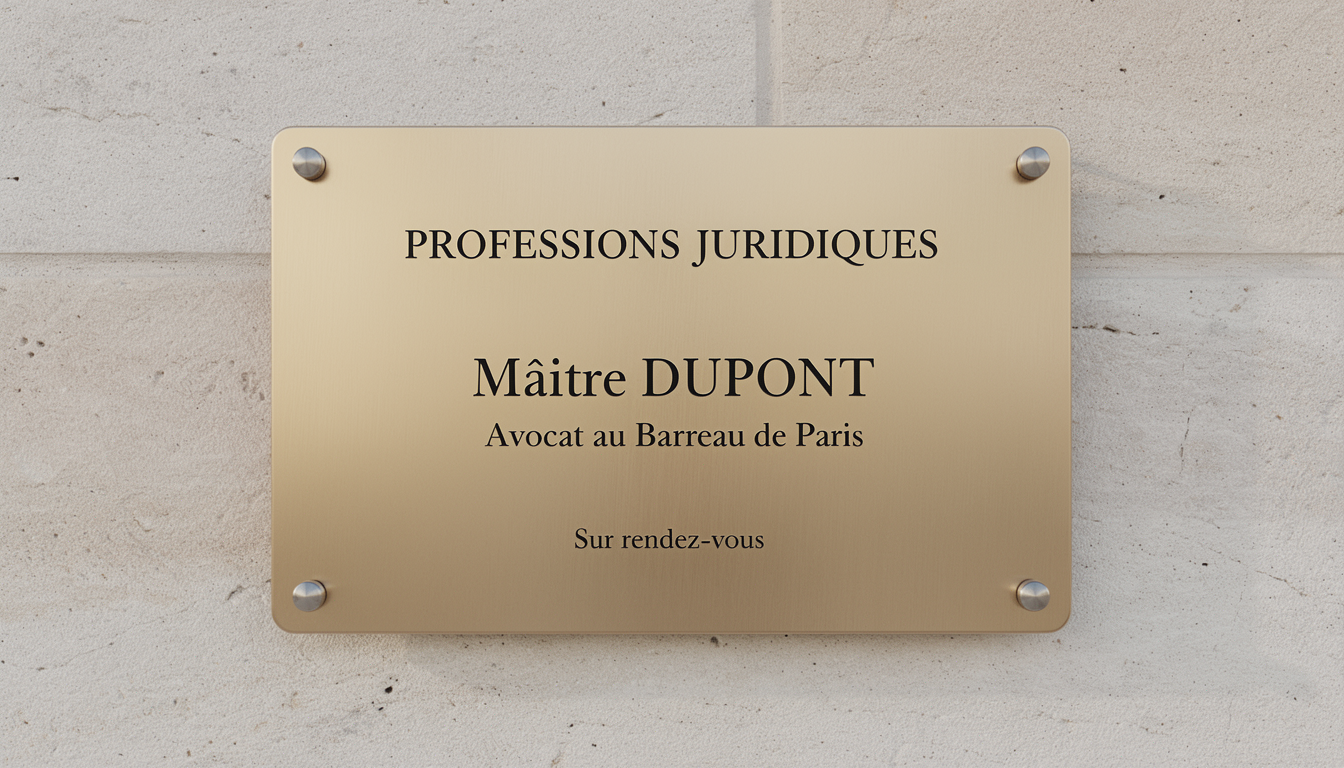
Laser engraving, screen printing, or digital printing: what to choose?
The technique used to inscribe information on the plaque influences both aesthetics and durability and compliance with standards. Texts and logos must be clear, legible, and durable.
Three main methods exist: laser engraving, screen printing, and digital printing. Each has its specificities, advantages, and limitations.
| Method | Visual Aspect | Durability | Adaptation |
|---|---|---|---|
| Laser engraving | Precise, contrasted, sophisticated lettering | Excellent weather resistance, minimal wear | Ideal on metal, plexiglass, or composite |
| Screen printing | Varied colors, possible finesse | Good resistance depending on UV treatment/protection | Effective on aluminum or glass, caution with relief |
| Digital printing | Very faithful rendering, wide graphic palette | Sensitivity to scratches/pollution, recommended for indoor use | On all supports, to be handled carefully outdoors |
In most cases for legal professions, laser engraving proves to be the best compromise between sobriety, robustness, and compliance. However, some choose screen printing or digital printing to stand out, provided they strictly adhere to ordinal prescriptions.
Fixings suitable for each type of wall
Installing the professional plaque securely is not just a technical detail, especially for old buildings in the city center or classified facades where any drilling must be carefully considered. The choice of fixing system directly affects the integrity of the material and the peace of mind of the professional.
On concrete or hard stone, opting for expansive metal anchors or chemical anchoring ensures excellent hold. On bricks or drywall, enlarged Molly anchors are ideal, while a glass facade may sometimes require adhesive systems or hooks that avoid drilling.
- Classic anchors (concrete, solid brick)
- Molly anchors (drywall, lightweight partition)
- Special adhesives and industrial glues (glass, smooth surfaces)
- Invisible suspension clips for interior panels
It is advisable to consult the condominium regulations before any operation, or even to seek the help of a certified installer if necessary.
The issue of advertising on lawyers’ plaques
For lawyers, the regulations strictly prohibit any advertising indication on the plaque. This means that no slogan, promotional hook, or mention that can be construed as a commercial incentive should appear. Only diplomas, official titles, contact information, and possibly hours are tolerated.
Violating this rule exposes one to disciplinary remarks, or even corrective measures ordered by the competent professional order. It is therefore advisable to carefully review the list of authorized elements and to systematically submit any new project for validation by the council of the order.
Getting your plaque validated before installation
A fundamental principle in compliance is the prior validation of the project with the relevant ordinal bodies. This step allows for verification that the plaque meets all the profession’s constraints: format, materials, textual content, positioning.
Many orders now provide practical guides or standard forms to facilitate this declaration. Keeping a written record of this validation then constitutes a valuable safeguard in case of disputes with the condominium or the town hall.
What risks and sanctions in case of non-compliance?
Equipping oneself with a non-compliant plaque is not trivial. Beyond the obligation to immediately replace the incriminated signage, the professional risks fines, disciplinary reprimands, or even proceedings before the administrative court.
These consequences are very real: each year, lawyers or other legal professionals receive warnings or injunctions for modification. Taking the time to do things by the book thus protects against unforeseen costs and preserves professional reputation.