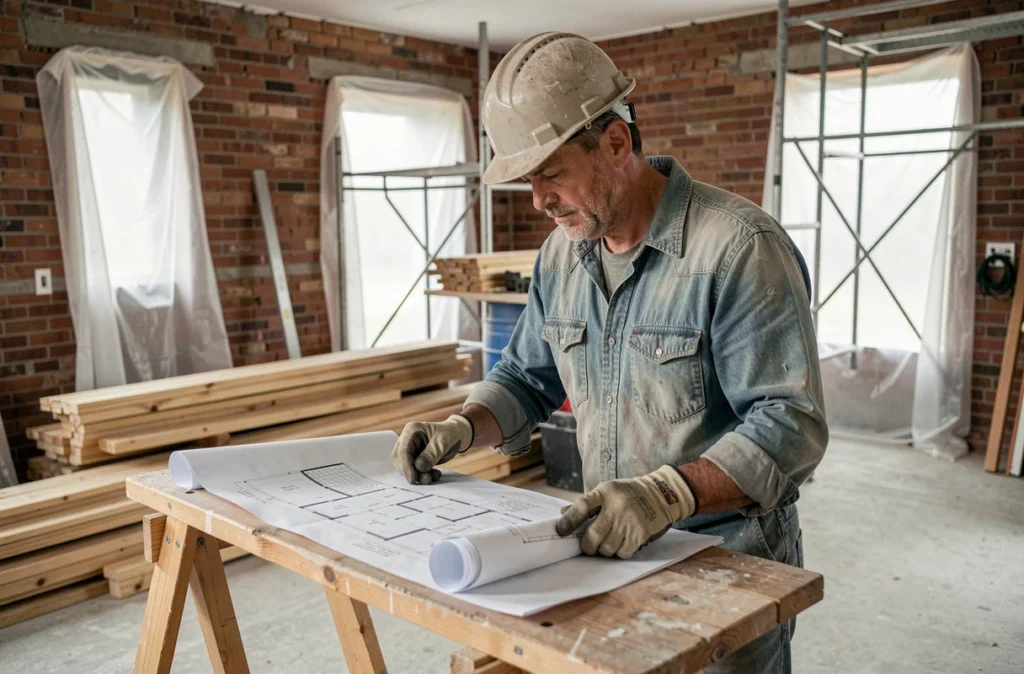
A cracked load-bearing wall, a gas boiler blocking access to subsidies, an energy performance certificate (DPE) classifying the housing as F: construction or renovation projects don’t start from a desire for change, but because a technical or regulatory constraint forces the issue. Understanding these constraints before signing the first quote can save months of delays and thousands of euros poorly allocated.
DPE coefficient and energy trajectory: what concretely changes the renovation scenario
Since the decree of August 19, 2026, the conversion coefficient of electricity in DPEs and energy audits has changed from 1.9 to 1.7, coming into effect on January 1, 2027. For a home heated by electricity, this modification can be enough to shift the label from one class to another, without having touched a single wall.
In practice, this means that a renovation project based on an audit conducted at the end of 2026 could aim for a target class that will no longer be correct a few months later. It is therefore recommended to request a simulation with the new coefficient before finalizing the quotes. Thinking in terms of DPE trajectory (gaining at least two energy classes) rather than piece-by-piece replacement remains the safest logic for accessing a substantial renovation pathway.
When planning the work on Maisons Euro France, this global approach allows for the coordination of insulation, ventilation, and heating in a coherent scenario, instead of stacking isolated interventions whose order may compromise the final efficiency.

Gas heating and renovation aids: the trap to check in advance
Decree No. 2026-822 of August 25, 2026, has tightened the conditions for accessing aids for substantial renovations. Keeping a gas heating system may now prevent obtaining MaPrimeRénov’ in the supported pathway. We have seen applications rejected after submission because the technical scenario planned to keep the existing gas boiler.
Checking the compatibility of the heating equipment with the aid criteria before signing a quote is no longer optional. If the home is equipped with a gas boiler, a decision must be made: either replace it (with a heat pump, district heating, or pellet stove depending on the configuration), or forgo this funding line and adjust the budget accordingly.
Choice between gesture renovation and global renovation
Gesture renovation (an isolated item: wall insulation, window replacement) provides access to more modest aids, and the amounts gradually decrease. For the substantial renovation pathway, the work must include several interventions on the envelope insulation and allow for a jump of at least two DPE classes.
Thus, we face a structuring choice right from the design phase:
- Coordinated global renovation: heavier initial budget, but access to the most significant aids (MaPrimeRénov’ supported pathway, eco-PTZ, enhanced CEE) and technical coherence between items
- Gesture renovation: more financially accessible in the short term, but risk of having to redo certain works if a global pathway is engaged later
- New construction or extension: not covered by MaPrimeRénov’, but subject to RE2020 which imposes high energy performance levels from the design stage
Feedback varies on this point, as each housing configuration (year of construction, surface area, climatic zone) alters the financial equation.
Order of interventions on a renovation site: insulation before heating
We still observe sites where the replacement of the boiler precedes the insulation of walls and roofs. The result: an oversized heating system for a home whose heat losses have been reduced afterward. The additional cost is real, and the overall performance suffers.
The building envelope is treated before the heating system. The logical sequence on a renovation site follows a precise order:
- Structural work (foundation repairs, load-bearing walls, framework) if necessary
- Thermal insulation of the envelope: roof, exterior walls, ground floors, joinery
- Ventilation: a VMC adapted to the new air tightness level, to avoid condensation and mold
- Heating and hot water production: sized according to the actual needs of the insulated home
- Finishing work: electricity, plumbing, coverings
Reversing insulation and ventilation creates a risk of humidity. A home made airtight without sufficient air renewal concentrates water vapor inside. Installing a double-flow VMC after insulating is not a luxury, it is a technical necessity.
Public aid calendar: a parameter to integrate into the project schedule
The aid calendar has become a determining factor in the sequencing of a project. Between MaPrimeRénov’, energy savings certificates (CEE), eco-PTZ, and local aids, each scheme has its own validity dates, ceilings, and eligibility conditions that sometimes change during the year.
Never start work before receiving funding approval. Starting a project before the aid notification can lead to outright rejection of the application. Therefore, the construction or renovation schedule should be based on processing times, not just on the availability of contractors.
Financial structuring: combining schemes without stacking them randomly
The eco-PTZ can be combined with MaPrimeRénov’ and the CEE, but the structuring must be coherent. The remaining cost after deducting the aids determines the actual need for equity or a traditional renovation loan. Having this remaining cost estimated by a Renov’ advisor (mandatory for the substantial pathway) avoids unpleasant surprises mid-project.
A well-structured home renovation project is prepared several months before the first shovel hits the ground. Start with the energy audit and aid structuring, then only launch the consultation of companies: this order protects the budget and secures the project timeline.