Family ties are built less through major events than through the repetition of daily micro-interactions. What distinguishes a family where communication flows well from one where everyone remains in their bubble often comes down to specific, sometimes counterintuitive habits. Strengthening family bonds on a daily basis relies on three concrete levers: the choice of the exchange location, the management of shared attention, and the quality of rituals rather than their quantity.
Family conversation location: an underestimated parameter
Most advice on family communication focuses on the content of exchanges. The location where these exchanges take place is rarely mentioned, even though it directly affects the quality of the discussion.
A study published in 2024 in The Journal of Early Adolescence shows that mothers and preteens prefer to talk about their difficulties in familiar places integrated into their routines. Preferences may differ from one family member to another: a child may feel more comfortable in their room, while a parent may prefer the kitchen.
Choosing the conversation location together, rather than imposing the living room couch as the only space for dialogue, facilitates exchange. This logistical detail changes the dynamic: a child who talks while walking or tidying their room shares more than a child sitting face-to-face with an adult who is waiting for a response. To explore other concrete avenues on family life, the site partagez.net to discover gathers useful resources on these topics.

Parental attention and screens: the real blind spot of family ties
The debate about screens and children overlooks a more determining aspect for family ties: the parent’s attention interrupted by their own phone.
It is not the presence of a screen in the home that weakens the bond. It is the moment it interposes itself. A parent checking their notifications while their child recounts their day sends a signal of disinterest, even if unintentional.
Identifying moments of shared attention
The French inter-ministerial report “Children and Screens, In Search of Lost Time,” submitted on April 30, 2024, suggests reasoning in terms of context rather than daily duration. The child’s age, the content being accessed, sleep, and the presence of an adult matter more than an arbitrary hourly quota.
For family ties, this translates into a simple rule: protect three uninterrupted digital-free slots during the day.
- The meal, where conversation flows naturally among family members, even if it revolves around trivial topics
- The bedtime moment, which remains for many children the only time they feel allowed to express their emotions of the day
- The daily commute (to school, activities), which offers a relaxed discussion framework as eye contact is not direct
Protecting these slots does not require reorganizing the entire family life. Putting the phone in another room during dinner has a measurable effect on the quality of exchanges, simply because attention is no longer fragmented.
Effective family rituals: regularity trumps ambition
The competitors of this article all recommend “creating family rituals.” The problem with this advice is its abstraction. A ritual that lasts no more than two weeks has no effect on family ties.
A family ritual works when it is short, repeatable, and associated with an already existing moment. Adding a habit to an existing routine requires less effort than inventing an additional slot in an already saturated schedule.

Examples of rituals rooted in daily life
Rather than planning a weekly “game night” that ends up being skipped, associating an exchange with an automatic gesture yields better results. For example, asking an open question at breakfast (“What makes you happy today?”) or sharing a brief story at bedtime.
Shared reading remains a ritual whose effectiveness on the parent-child bond is documented. It is not only for young children: reading a passage aloud to a teenager, or discussing a book in progress, maintains a space of low-stakes conversation where no one feels evaluated.
The shared meal also deserves special mention. Eating together regularly, even if the meal is simple and quick, creates a space where daily emotions naturally surface. It is not the gastronomic quality of the meal that matters, but the regularity of presence.
Family communication with children: adapting the channel to age
Communicating with a four-year-old and with a fourteen-year-old does not use the same tools. Family communication becomes more effective when parents adapt the channel rather than demanding a one-size-fits-all format.
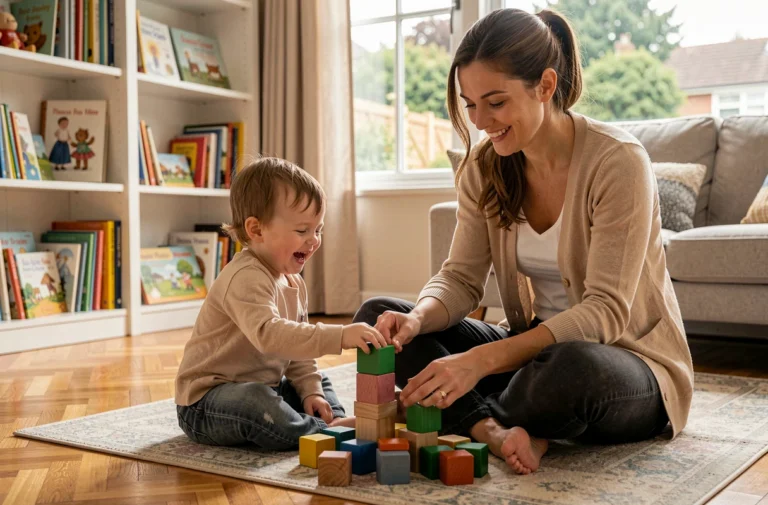
With young children, listening first comes through play and movement. A child who is drawing or building something finds it easier to share what is on their mind than a child who is directly asked, “How was your day?”.
With teenagers, the written channel (a message, a note left on the table) can complement the oral. Some preteens find it easier to express an emotion in writing than face-to-face, especially when the topic makes them uncomfortable. Accepting this detour does not weaken the bond; it preserves it by respecting the need for autonomy typical of this age.
Parents who vary communication formats daily often find that moments of confidence arise where they are least expected: in the car, while cooking, during a walk. Family ties are strengthened less in large planned discussions than in these interstices where attention is available without being directive.