
Converting 69 psi to bar seems simple: one multiplication, one result. In reality, this operation generates discrepancies far more frequently than one might imagine, even among experienced technicians. The exact conversion factor between psi and bar (1 psi = 0.0689476 bar) has enough decimals that a misplaced rounding can distort the final value by several tenths of a bar. At a service pressure of around 4.7 bar, these tenths matter.
Why the conversion error often exceeds the gauge error
The gauges used in workshops or inflation stations are classified by accuracy class according to the EN 837-1 standard. On a standard gauge of class 1.6 with a measurement range of 0 to 16 bar, the permissible error reaches about 0.256 bar. This is the instrumental tolerance, the one that is accepted as unavoidable.
An incorrect conversion of 69 psi to bar, for example by dividing by 10 instead of 14.5, can generate a discrepancy greater than 1 bar. The human error in conversion then eclipses the margin of error of the device, sometimes by several times its regulatory tolerance. The problem does not come from the gauge, but from the operator who miscalculates the read value.
This point remains poorly documented in consumer guides, which focus on the formula without addressing the chain of cumulative errors between reading, conversion, and adjustment. When consulting the conversion errors for 69 psi on Mindtrap, one better understands the extent of possible confusions regarding this precise value.

Conversion of 69 psi to bar: the exact factor and rounding pitfalls
The mathematical relationship is as follows: 1 psi equals 0.0689476 bar. To convert 69 psi, you multiply 69 by 0.0689476, which gives 4.75538 bar. So far, nothing complicated.
The trap appears at the moment of rounding. Depending on whether you round to 4.75 bar, 4.76 bar, or 4.8 bar, the discrepancy from the exact value varies. On a tire whose recommended pressure lies within a narrow range, rounding to 4.8 bar instead of 4.76 bar already represents a significant excess.
The riskiest mental calculation shortcuts
Several simplified methods circulate online and in workshops:
- Dividing the psi value by 15 instead of 14.5 – this shortcut gives 4.60 bar for 69 psi, a deficit of more than 0.15 bar compared to the exact result.
- Using the ratio 1 bar = 14 psi, which produces 4.93 bar for 69 psi, an overestimation of almost 0.18 bar.
- Rounding the conversion factor to 0.07 instead of 0.0689476, which gives 4.83 bar, an excess of 0.07 bar that adds to other inaccuracies in the measurement chain.
None of these shortcuts are catastrophic when taken in isolation. But when the calculation approximation accumulates with the gauge tolerance and the pump inaccuracy, the total discrepancy can exceed half a bar.
Gauge reading zone: a parameter overlooked in psi-bar conversion
Industrial recommendations specify that the usual pressure should be between 33% and 66% of the gauge’s measurement range to ensure a reliable reading. Below or above this range, accuracy degrades.
For a conversion of 69 psi (about 4.76 bar), a gauge graduated from 0 to 6 bar places the reading at about 79% of the scale, beyond the appropriate zone. A gauge from 0 to 10 bar positions the reading at 47%, well within the recommended range.
This choice of instrument is not trivial. An improperly sized gauge amplifies the reading error, which adds to the conversion error. The final result can deviate significantly from the target value, without the user being aware.
Relative pressure and absolute pressure: the confusion that distorts everything
The majority of gauges display relative pressure (gauge pressure), meaning the pressure above atmospheric pressure. The technical specifications of some equipment, however, sometimes express pressure in absolute terms, which includes atmospheric pressure (about 1.013 bar at sea level).
For 69 psi in relative pressure, the result is 4.76 bar. In absolute pressure, you would need to add about 1 bar, making it 5.77 bar. Confusing the two amounts to under-inflating or over-inflating by a whole bar. The contexts where this distinction matters are primarily industrial (hydraulic circuits, autoclaves), but the error also occurs when technical sheets imported from the United States do not specify the nature of the measurement.
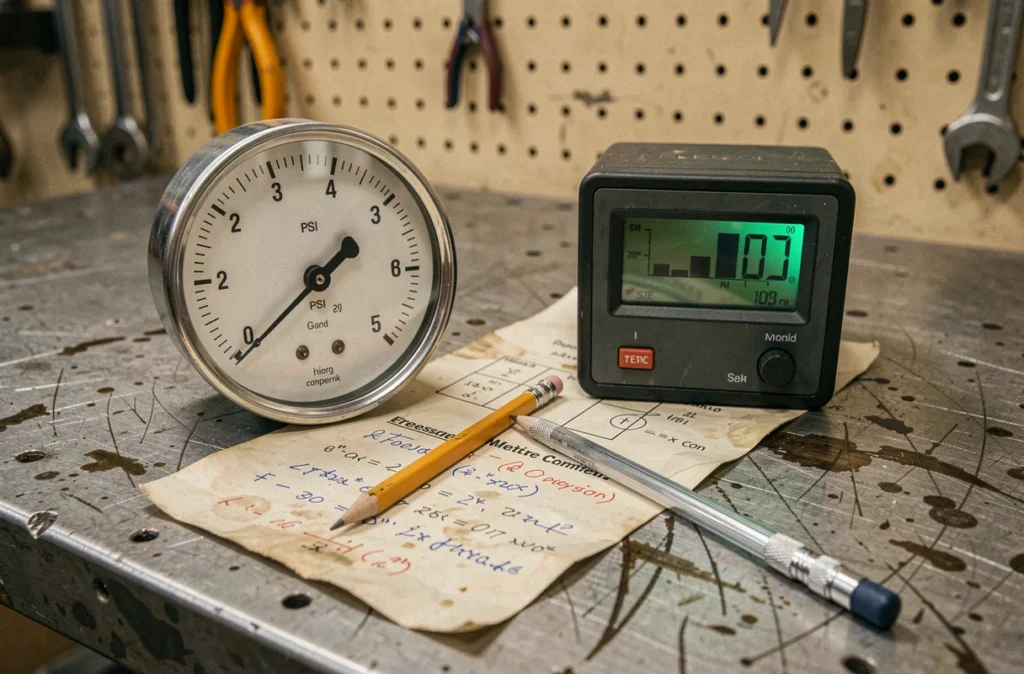
Verify your conversion of 69 psi to bar: a reliable method in three steps
Rather than an online converter whose algorithm reliability is unknown, a manual check remains the safest safeguard.
- Multiply 69 by 0.068948 (official factor rounded to six decimals). The result should be between 4.75 and 4.76 bar.
- Compare this result with the value displayed by the gauge. If the discrepancy exceeds 0.3 bar, recalibrate the instrument or check its measurement range.
- Confirm that the original specification indeed refers to relative pressure (psig) and not absolute pressure (psia). In the absence of mention, the usual convention for tires is relative pressure.
A conversion discrepancy that seems minimal at 69 psi can represent several times the accepted tolerance for a standard class gauge. Rigorous attention to the conversion factor protects the reliability of the result more than purchasing a higher precision instrument.
The next time a gauge shows 69 psi, the most useful reflex is not to look for a converter, but to check three things: the factor used, the reading range of the instrument, and the nature of the measured pressure. These three checks take less than a minute and eliminate almost all documented errors regarding this conversion.